No gaps, no overlaps
Secret Weapon #001
12 March 2025
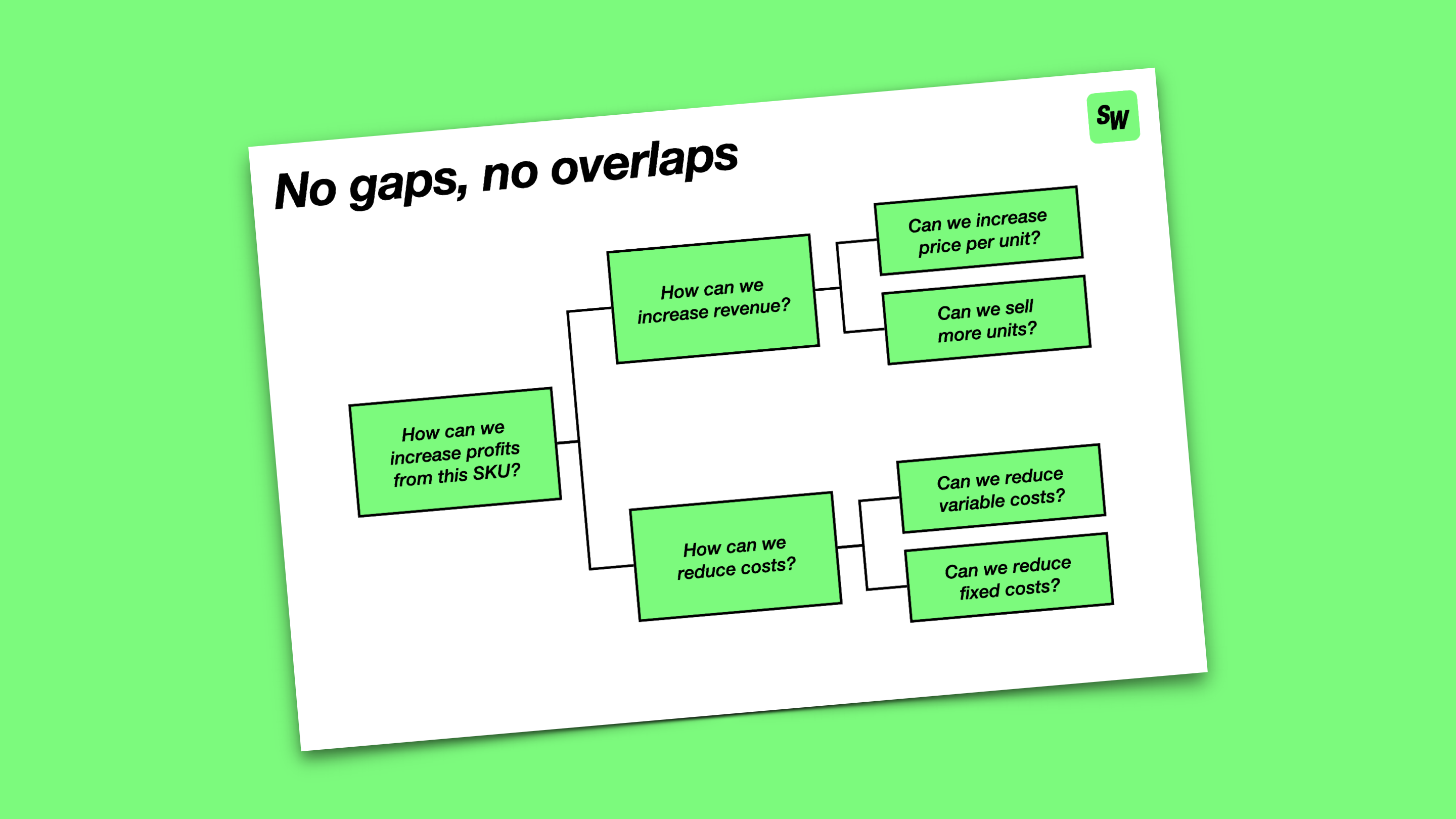
Interesting problems are usually interesting because they are complicated. In many cases the best approach to tackling a complicated question is to break it down into a bunch of simpler questions. The way you do this can make a big difference to how efficiently you can figure out an answer.
The first thing most consultants are taught is that when you break a complicated question down, the simpler questions you end up with should be mutually exclusive and collectively exhaustive (MECE for short – usually pronounced “mee-cee”, though this is disputed!).
Mutually exclusive means that each of the simpler questions can be thought about in isolation, without getting tangled up in other aspects of the problem.
Collectively exhaustive means that when taken together, the simpler questions should address all the important aspects of the original problem with nothing left out.
So MECE is really just a fancy way of saying no gaps and no overlaps.
To take a concrete example – let’s say your company sells widgets, and you’re interested in ways to increase the profit you make on a particular SKU. You might break the problem down into revenue and cost drivers, as illustrated in the chart at the top of this article.
In this example it’s straightforward to see how each bigger question is related to the smaller ones. In fact, what I’ve sketched out is MECE by definition: profit equals revenue minus costs, and so on.
In practice most problems don’t have a simple algebraic structure to lean on. Luckily there are plenty of other tried-and-tested approaches for breaking big questions down into smaller parts. I’ll return to those in a future post.