Making MECE practical
Secret Weapon #008
30 April 2025
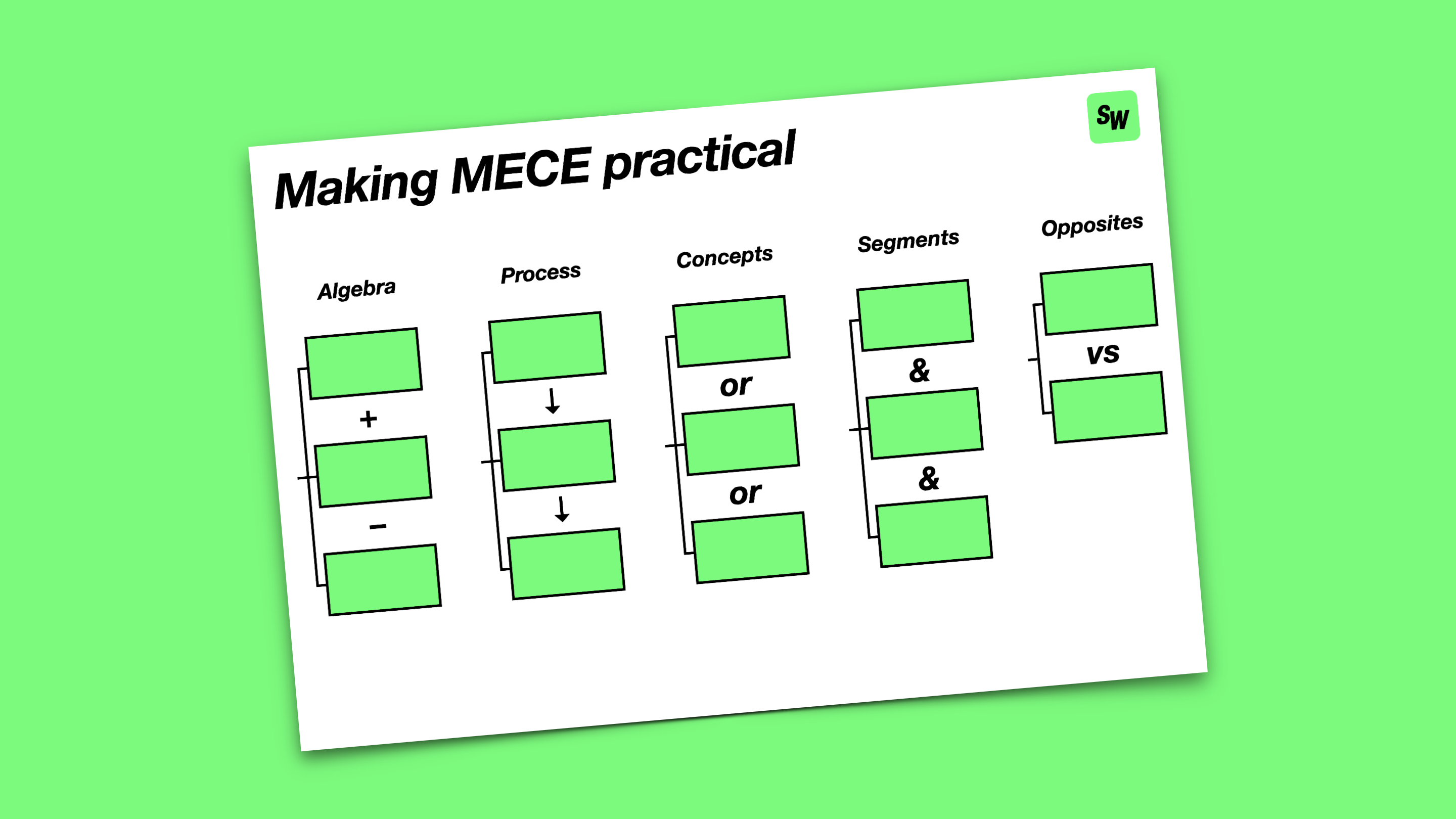
When you’re breaking a problem down it often helps to draw an issue tree. Well-structured issue trees are MECE: mutually exclusive, collectively exhaustive.
So far, so good. But once you get past toy examples, finding good ways to break a difficult question or sub-question down into MECE components can be tricky.
Here are five tried-and-tested ways to get a foothold:
- Algebra. Use this when you can see a well-defined mathematical relationship between the different components of the question
- Process. Use this when there’s a clear process flow or sequence (start, middle and end) embedded in the question
- Concepts. Use this when different aspects of the question relate to different categories of ideas or ways of thinking about what’s happening
- Segments. Use this when you can relate different components of the question to different groups of people or parts of a market
- Opposites. Use this to generate a quick decomposition that is MECE pretty much by definition
In practice the first three of these are the most powerful and will help you make real headway when wielded effectively. The latter two can sometimes be helpful but are typically less incisive – they can help you break a question down but are less likely to spark insights on their own.
As with most things, the best way to get proficient with issue trees is to practice. The more you work with them, the better your intuition will get about how to decompose big questions into smaller ones.